
Are You Still Standing on the Social Distancing Sticker?
Recently, I went to the doctor for my annual appointment.
In advance of the appointment, I received multiple emails and text messages that required me to fill out an extensive online form to verify my health and medical information. They said this would save me time when I got into the office. So of course, I complied, even though this was not my first time with this doctor or this office or any new health needs.
On the day of the appointment, I did not receive a reminder email, nor was there any communication about where to park. For this doctor, there is a large parking lot, but it’s not super obvious where the parking lot is compared to the medical building. And since I only go once a year, I couldn’t remember the location. (If you know me well, you know I am TERRIBLE at directions.)
But I found my way and entered the elevator to go up to my doctor’s office. And I saw something shocking.
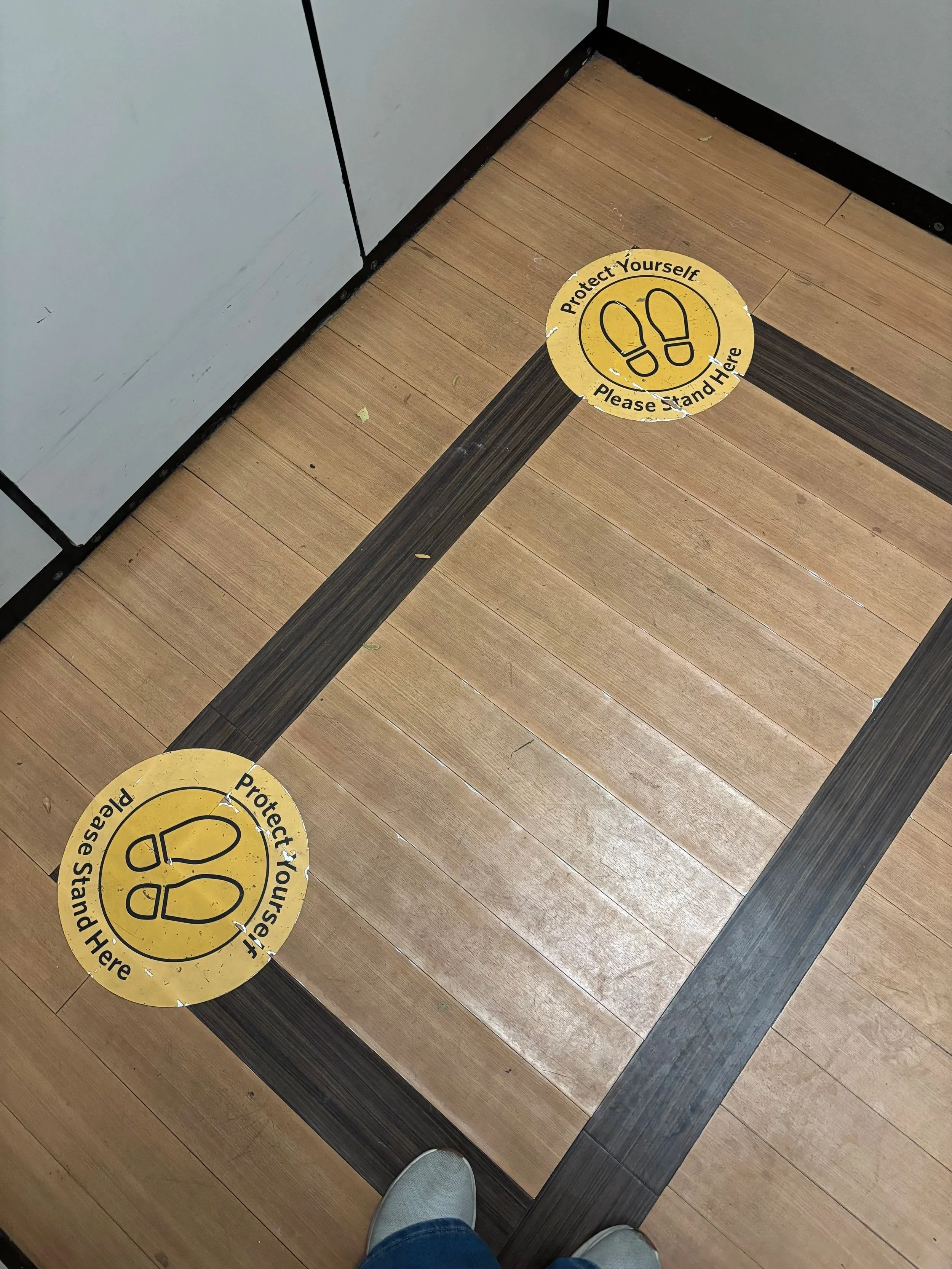
I saw two large stickers on the floor that said:
“Protect Yourself. Please stand here.”
For those of you who may have forgotten about what happened six years ago, we, collectively as a society, went through a global pandemic. Covid-19. Remember? Six years ago?
Remember social distancing? The need to stay physically apart?
Well, this elevator, in late 2025, still had the stickers on the floor.
I was flummoxed.
Then, I entered the office. The receptionist checks me in and gives me a lengthy paper form. I look at this and say to her, no, I already filled out an equally lengthy form online.
She explained to me, Thanks so much for doing that, but the online system doesn’t get relayed to our office, and therefore, you have to fill this out too.
As I’m sure you can imagine, I was annoyed.
So why am I sharing this charming anecdote with you?
Because, consider the social distancing stickers as a symbol for your nonprofit.
What institutional practices of yours are stuck in the before times? What used to work to build stronger donor relationships but may not be working in the same way anymore?
Duplicate forms are not just annoying and a waste of time, but it allows for more human error.
And dare I say, could there even be a lack of trust between teams that use different systems? Consider if your communications team tracks their data in the same place as your development team? What about your accounting team? And then consider, why is that?
What is your executive team and board doing to ensure the teams aren’t just saying they have shared goals, but they’re using the same systems and data to achieve them?
Let’s consider one more piece for your nonprofit. When your systems, operations and communications seem disjointed or unclear, what do your donors perceive?
It’s probably not trust-building. Instead, it is confusion or even that you’re trying to hide something. This hurts your trust with your donors and is incredibly hard to build after it’s lost.
Consider the different generations you are working with. When older donors struggle with your website, they give up. Too much friction is bad.
And your younger donors? Do you think they will stay connected to you once they find your communication opaque and duplicative? Probably not.
How will you increase your donor retention and lifetime value of your donors when they give up on filling out a donation page or don’t believe your messages?
Look, you need to stay up to date with changes. What once made sense, may now look outdated.
Images that once looked modern and timely, now feel outdated and time-specific (please do me a favor and review your images for people in masks or forms that request a home phone number or fax number).
The world is changing. Technology and AI. Generations in the workforce and in your donor base. The Great Wealth Transfer. Public policy.
Your nonprofit has to stay up to date or else it will fall behind.
So think about what message you are sharing. Is it helpful to the person receiving the message? Is it timely? Is it confusing? Is it consistent with what you’ve shared before?